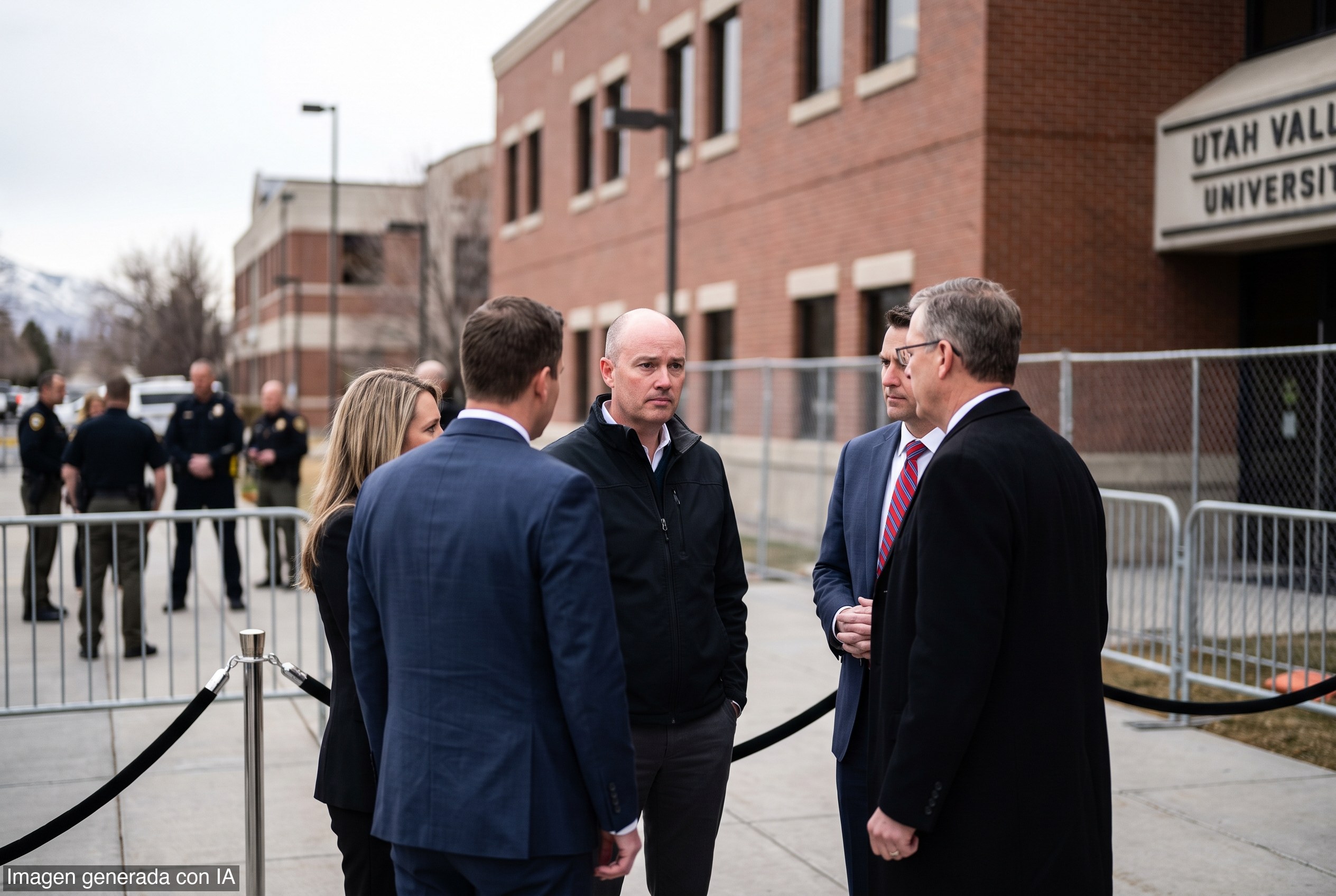
Almost exactly one year ago, on September 10, 2025, Charlie Kirk was speaking onstage at Utah Valley University when, in the words of Utah Governor Spencer Cox, 'a crack splintered the air.' Kirk, 31 years old and a father of two, was shot in the neck and killed in front of millions of viewers.
Cox was at the scene within hours. He has now written about what he witnessed in an excerpt published by The Free Press from his new book, Off Ramp: How to Be a Peacemaker in an Age of Contempt.
The governor learned of the shooting at lunch with his staff. His assistant entered the room and delivered the news. Cox stepped into the lobby, where his Highway Patrol security detail was waiting. 'Sir, there has been an incident at Utah Valley University,' an officer told him. 'Charlie Kirk has been shot.'
Cox describes the weight of that moment as something every governor is warned about. 'Tragedy will come for each of us when we least expect it,' he writes, recalling the training newly elected governors receive from sitting governors — what he calls 'Baby Governor School.'
In the days that followed the killing, Cox spoke with The Free Press's Peter Savodnik about 'which direction he thought Americans, and America, would choose' in the aftermath of the murder. The editors of The Free Press, introducing the excerpt, offer a frank assessment of what has since become clear: Kirk's death 'was not the wake-up call some hoped it would be.' Instead, according to the editors, 'the killing unleashed deranged conspiracy theories, fueled radicalization, and deepened the rage that threatens to define our politics.'
Cox emerged in the immediate aftermath as a public voice calling on Americans to repair what he described as a broken politics. His book, framed around the concept of peacemaking in an age of contempt, is his attempt to answer the question the murder forced into the open.
The record here is worth sitting with. A prominent public figure was shot dead on a university stage, on camera, in front of a national audience. The institutional response — political, media, civic — did not produce the reckoning Cox and others called for. It produced more noise, more suspicion, more fracture.
What Cox saw firsthand in those 48 hours matters not because it changes the facts of the case, but because it documents what American institutions looked like under that kind of pressure. A governor arriving at a crime scene. A security detail delivering the news in a hotel lobby. A country watching and, by the editors' own account, choosing the wrong direction.
The principle at stake is not complicated. A society that cannot mourn a political killing without immediately sorting it into partisan ammunition has lost something more than one man. It has lost the shared floor of civic life on which disagreement — real, honest, productive disagreement — depends. Cox's book is a case for recovering that floor. Whether the country is interested is, as of this anniversary, still an open question.