By the end of 2006, the war in Iraq was failing. General David Petraeus, writing in The Free Press, does not soften that judgment. The bombing of the al-Askari mosque in Samarra in February of that year had accelerated sectarian violence and pulled Iraq into what Petraeus describes as 'an increasingly vicious Sunni-Shia civil war.' Al-Qaeda in Iraq and Sunni insurgent groups controlled substantial areas. Shi'ite militias operated with growing impunity. Iraqi security forces could no longer arrest the downward spiral.
The numbers were unsparing. In December 2006, an average of 53 Iraqi civilians were killed by violence every 24 hours in Baghdad alone.
Washington had reached its own breaking point. Public support for the war had fallen dramatically. President Bush's Republican Party had just lost control of both houses of Congress. The bipartisan Iraq Study Group — of which future defense secretary Robert Gates was a member — had recommended a course anticipating a substantially reduced American combat role. Many senior military leaders were deeply skeptical of sending additional forces, advocating instead for accelerated transition to Iraqi forces, more trainers and advisers, or other modest measures aimed at withdrawal.
Virtually every political incentive, Petraeus writes, pointed toward reducing America's commitment.
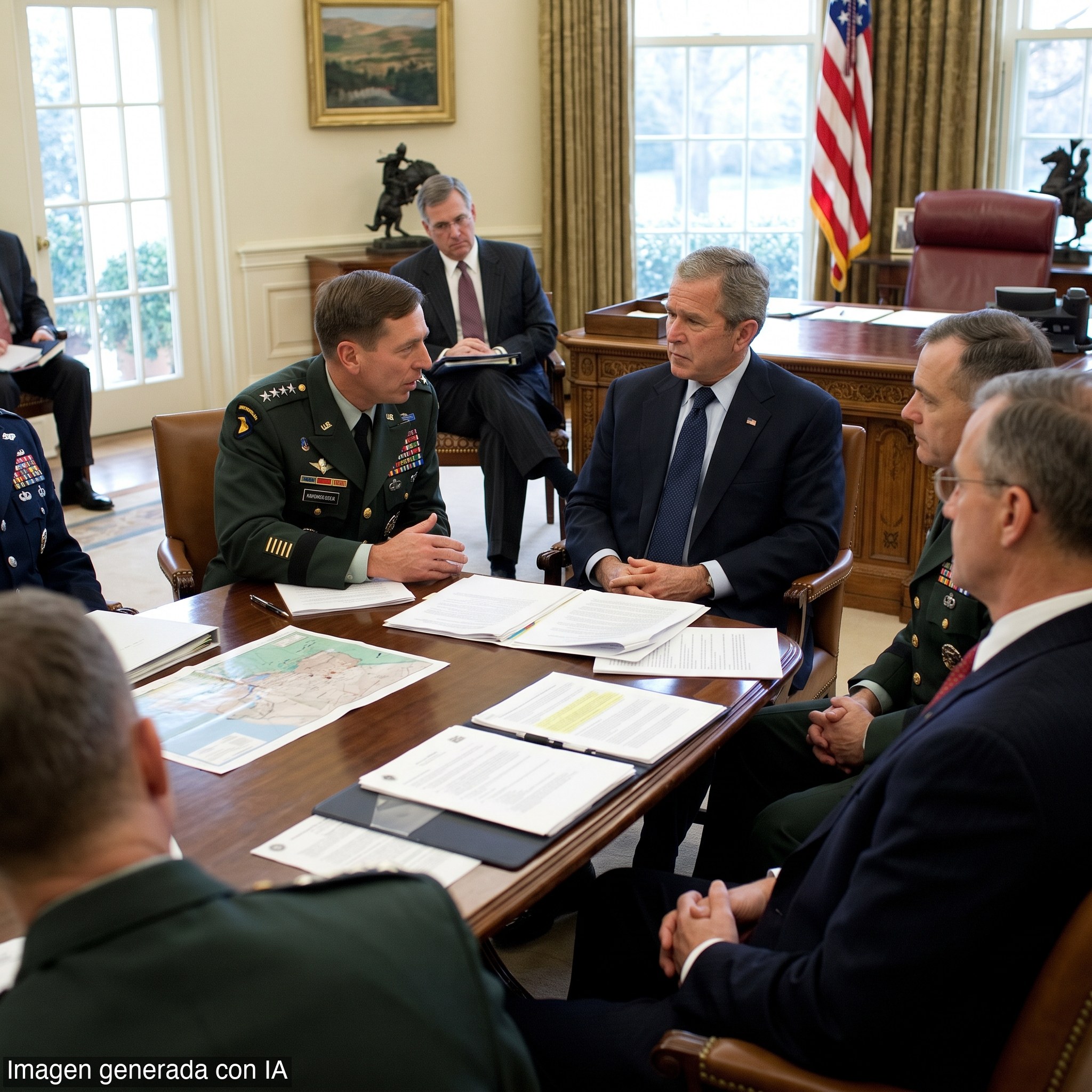
Bush chose instead to increase it. In early 2007, he appointed Petraeus — who had already served in Iraq as a two- and three-star general — to lead allied forces there, heralding the strategy that became known as 'the surge.' Petraeus calls the decision 'one of the most courageous presidential decisions of the 21st century.'
His essay, published as part of a retrospective on the 25 years since September 11, is a careful account of what presidential leadership looks like when it runs directly against the momentum of events. 'Courage in high office,' Petraeus writes, 'does not mean knowing that a difficult decision will succeed.'
The record is public. The invasion of Afghanistan in late 2001 had quickly toppled the Taliban and expelled al-Qaeda from its most crucial sanctuary. The 2003 invasion of Iraq toppled Saddam Hussein's regime. What followed — the post-regime coalition authority's significant missteps, the erupting insurgency, the loss of popular support despite Bush's 2004 reelection — is also on the record, and Petraeus does not pretend otherwise.
---
What Petraeus is really describing is the rarest thing in democratic governance: a leader who reads the incentive structure clearly, understands that every arrow points one way, and then accepts personal responsibility for going the other direction. That is not stubbornness. It is the willingness to absorb political cost in exchange for a chance at a better outcome — and to own the consequences either way.
The lesson is not that the surge was without cost or controversy. It is that the alternative — managed retreat dressed up as strategy — was the path of least institutional resistance, not least risk. Twenty-five years on from September 11, as the United States navigates a more crowded and contested world, the question Petraeus raises is worth sitting with: how many leaders, facing the same arithmetic, would have made the same call?