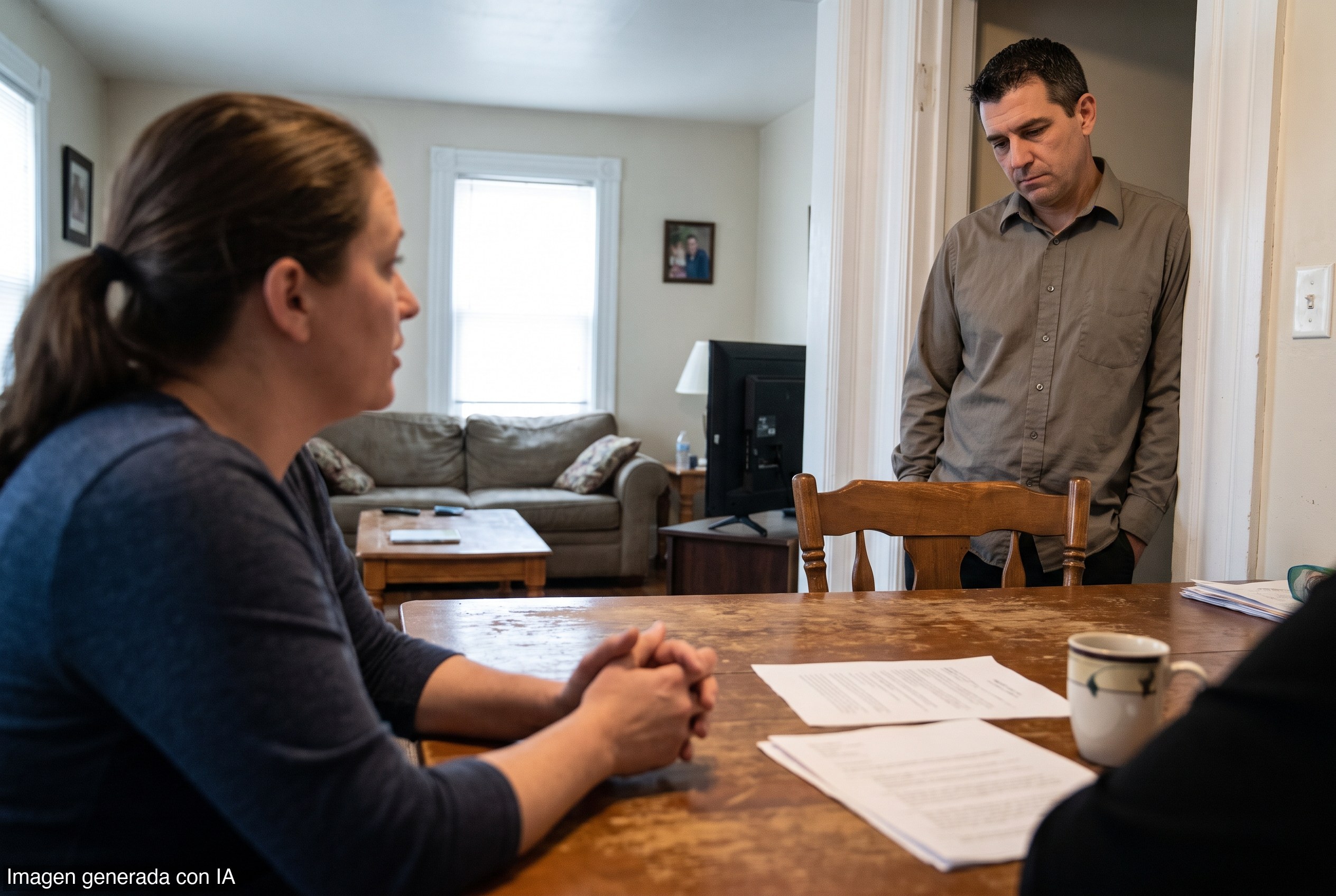
Jona Affholder was around eight weeks pregnant when, at a little after 4 a.m. on December 18, 2024, she says she woke up to find her boyfriend on top of her.
For a split second, she thought he was hugging her. Then, she told reporter Madeleine Kearns, she realized he was pinning her down, forcing his fingers into her mouth. 'I truly thought he was going to kill me,' Affholder said.
After a two-minute struggle, she understood what was happening. 'I knew, after that point, that it was an abortion medication,' she said.
Affholder, then 27, from Toledo, Ohio, had been dating 32-year-old Dr. Hassan-James Abbas — a local surgeon — for around three months. By her account, the relationship had seemed promising. 'All I'd ever seen from him was just like a completely normal person who led with kindness,' she said. 'He seemed very genuine.'
A week before the alleged assault, Affholder told Abbas she was pregnant and that she wanted to keep the baby. She says he became 'aggressive,' 'angry,' and 'nasty,' insisting the pregnancy would bring shame on his family and demanding she have an abortion. He also admitted, she says, that he had an estranged wife to whom he was still legally married.
Affholder ended the relationship. Days later, Abbas reached out and apologized. 'He was crying, explaining that he was so sorry for the things that he said and that he did not want me to have an abortion and that we would figure it out,' she recalled. She gave him a second chance.
For the following week, Abbas was, by her account, unusually attentive — making her teas, buying her hot chocolates, monitoring what she ate and drank. 'I wasn't really finishing the beverages,' Affholder said. 'I'm not a big tea person, so I sipped on it for a little bit, and then I dumped the rest down the drain.'
In hindsight, she believes Abbas had been lacing those drinks with abortifacients, and resorted to physical force only when those attempts failed.
When she fought him off that night, Affholder called 911 at 4:50 a.m. — a time verified by phone records, according to Kearns's reporting. Abbas took her phone and ended the call. She ran toward the front door; he blocked her. She made it to the kitchen to rinse her mouth.
The piece, reported by Kearns for The Free Press, notes that the Biden administration had enabled Americans to receive medication abortion by mail, delivered to their homes.
---
The argument for mail-order abortion medication was, at its core, an argument about autonomy: that women should control their own reproductive decisions, free from interference. That argument is not wrong. But autonomy is only meaningful when the choice is actually the woman's.
Affholder's account — if borne out — describes the precise inversion of that principle. The same accessibility that was sold as liberation from coercive partners may, in at least some cases, have handed those partners a new instrument of control. Follow the incentive, not the press release. When a medication can be ordered online, delivered discreetly, and administered without a prescription, the question of who is actually making the reproductive 'choice' becomes considerably more complicated. The record on that question is only beginning to be written.