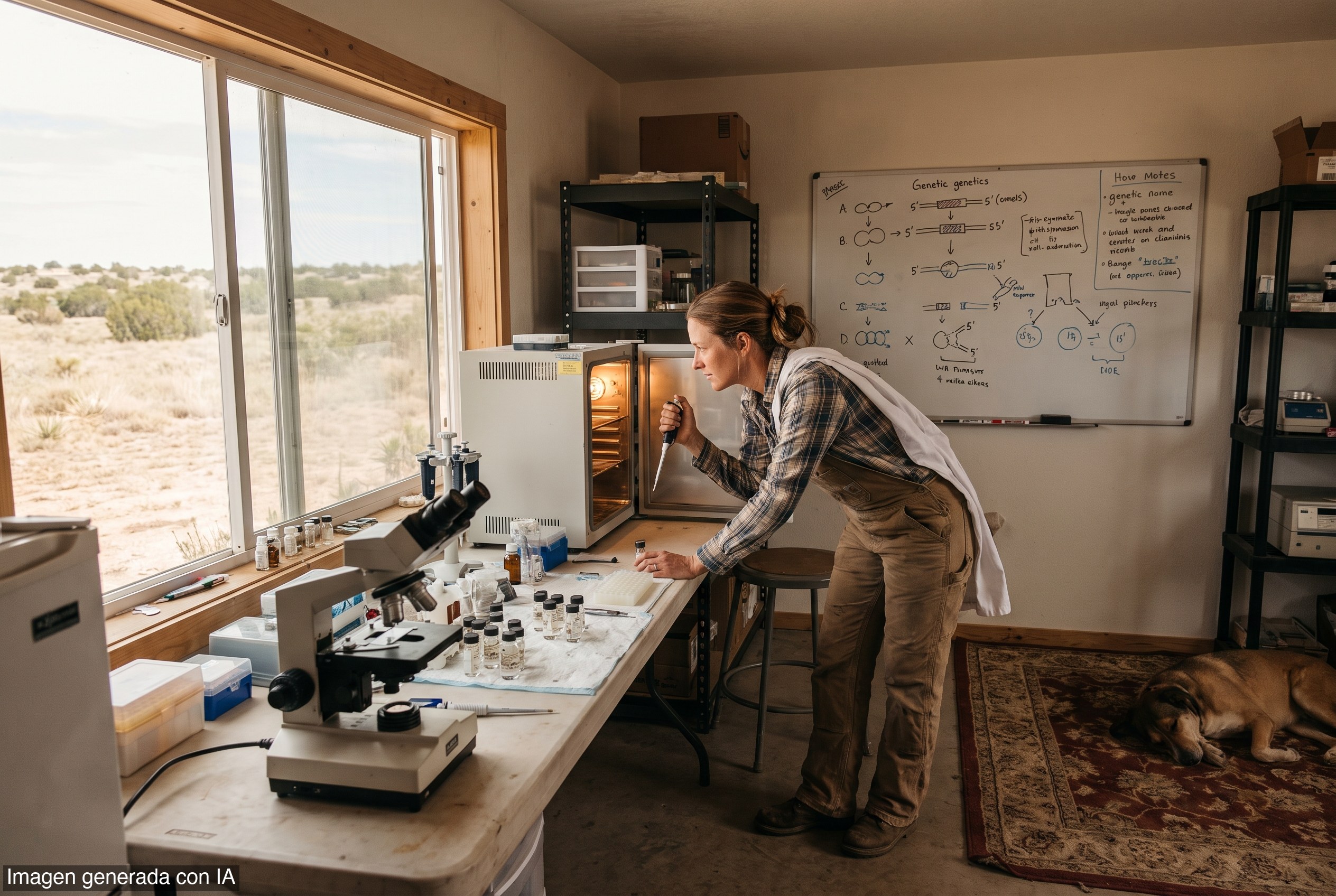
Pilot Point, Texas, is not where one expects to find the frontier of synthetic biology. Yet that is where Josie Zayner sat at Bebo’s, a roadside diner packed with American flags, Trump banners, old signs, and the kind of local clutter that reads like a revolt against polished coastal taste.
Zayner is no ordinary founder. She is a former NASA research fellow, a world-famous biohacker, and the CEO of a gene-editing start-up. She told the record she has called Austin home since 2021, and she said the people there show more warmth than you would ever experience in San Francisco. She also called this 'the soul of America.'
Her company is racing to gene-edit animals, with dragons and unicorns as the long-term goal. That is not a metaphor. It is the stated horizon of a business built on rewriting life itself.
The story behind Zayner helps explain why she attracts both attention and alarm. In the 2010s, she became infamous for a string of public gene-editing stunts and experiments in California. She spliced jellyfish DNA into her own skin. She injected herself onstage at a conference with a CRISPR solution designed to knock out the gene that limits muscle growth. She performed her own fecal transplant to address chronic gut problems. She also livestreamed herself on YouTube self-injecting a Covid DNA vaccine.
Her critics say that amounts to messing with Mother Nature. Zayner’s answer is blunt: 'Being a god is just being 100 years in the future.' That is the sort of sentence Silicon Valley once used to dress up ambition as inevitability. In Texas, it lands differently.
What is at stake here is not only one founder’s taste for spectacle. It is the larger question of how much room a free society gives to experiments that move faster than the public’s sense of caution. Innovation has never arrived wearing a halo. It comes with risk, uncertainty, and the occasional mess.
But the incentives matter. When the prize is a new market, a new platform, or a new species of prestige, the pressure is always to move first and explain later. That is where the administrative state, public alarm, and private ambition begin to collide.
Say it plainly: the country is once again deciding whether it wants its pioneers to be judged by results or by the discomfort they cause. The answer will shape not only biotech, but the terms on which American enterprise is allowed to chase the future.