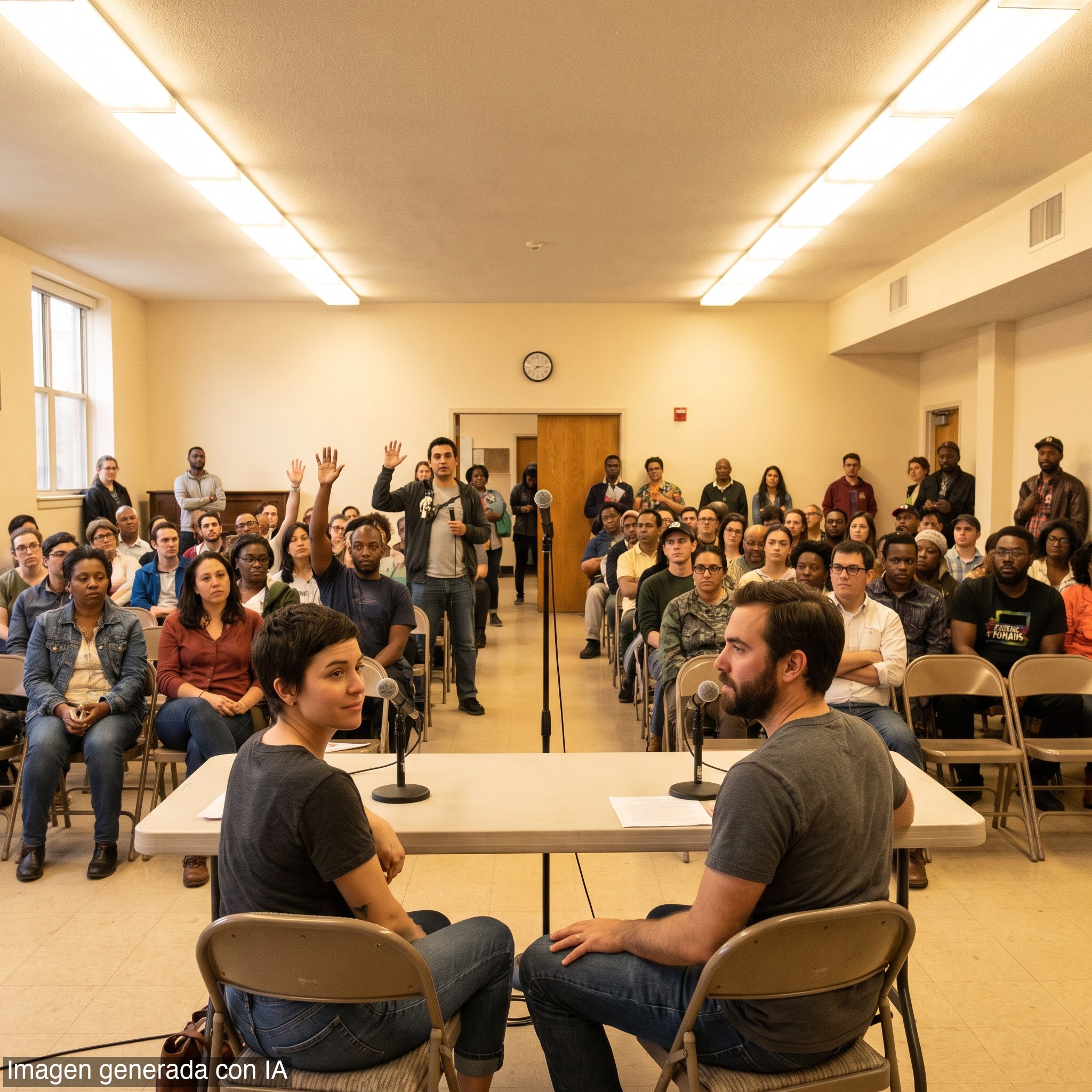
The meeting was held in a dimly lit Park Slope bar. A few dozen members of the South Brooklyn branch of the Democratic Socialists of America had gathered on a late August evening, and the item on the table was whether Grace Mausser and Gustavo Gordillo — the two co-chairs of New York City DSA — deserve $95,000 salaries.
Mausser made the case herself. Then the room weighed in.
Not everyone was persuaded. One woman said she wasn't sure she could continue as a member after watching local party leaders 'defend things that I don't agree with,' including on police-related issues. A 10-year member objected on procedural grounds, noting that neither co-chair is working class to begin with. A third member, Alex Rivera, said he didn't oppose paying leadership in principle — but questioned how salaried co-chairs would be held accountable, given that the chapter has no real budget process, no member vote on meeting agendas, and relies on borrowed bar space for its monthly gatherings.
'This feels very much top-down leadership instead of like, bottom-up,' Rivera said, according to a recording of the meeting reviewed by The Free Press.
Two days later, the resolution to approve the co-chair salaries passed overwhelmingly anyway.
The episode is a small scene inside a larger story. The DSA is riding what the organization itself describes as its best-ever electoral stretch, and it now holds real hope that a soon-to-be-elected bloc of socialist Congress members might extract major concessions from establishment Democrats and begin reshaping the party in the DSA's image. The coalition is, by its own account, at an inflection point.
And yet the fault line that surfaced in that Brooklyn bar is the same one running through the organization nationally: a split between pragmatists who prioritize winning elections and purists who do not want to compromise their Marxist principles. The salary dispute crystallized it. Members who have spent years arguing that capitalism concentrates power and insulates elites from accountability found themselves watching their own leadership approve significant compensation through a chapter with no formal budget process — and no member vote on the agenda that produced the resolution.
Follow the incentive, not the press release. The DSA's internal tension is not merely ideological; it is structural. Organizations that grow acquire resources. Resources require administrators. Administrators develop interests. Those interests do not always align with the rank and file who fund them. This is not a novel observation — it is, in fact, one of the oldest critiques in the socialist tradition itself. That the DSA is now living it out in a Park Slope bar, with a recording running, is the kind of detail that does not need an adjective.
What the Brooklyn vote reveals is that the DSA's most serious opponent may not be the Republican Party or the Democratic establishment. It may be the iron logic of institutions: the same logic its members have spent years applying to everyone else.