My head was bowed in prayer when I heard something strange coming from the pulpit.
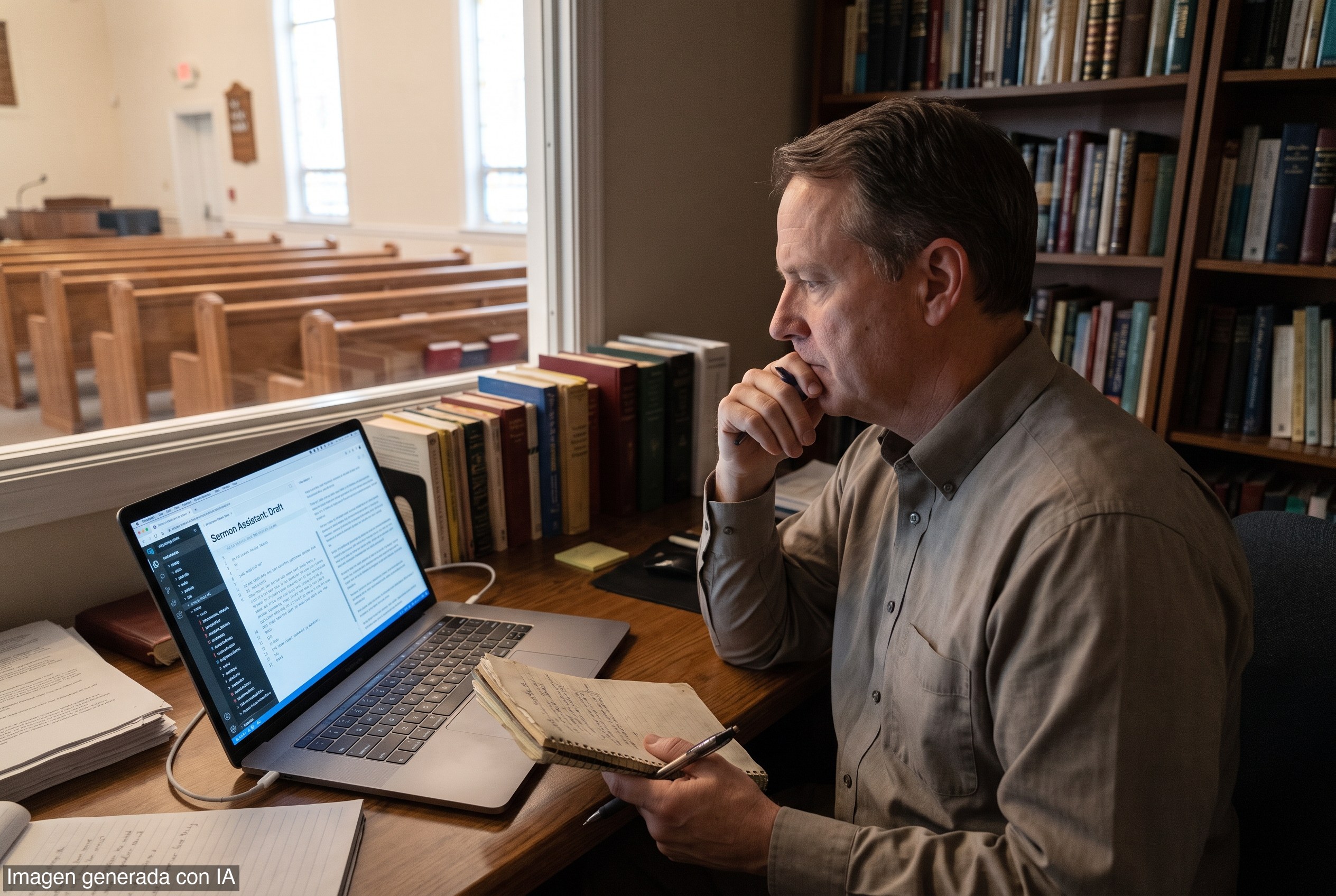
Josh Code, writing in the first person, says a friend of his stood before a congregation of 200 people and prayed over the day’s offerings. The words, he says, bore the marks of AI writing that made him wince: 'It’s not X—it’s Y' and a conspicuous preference for lists of three.
After the service, Code confronted his friend. The friend admitted the prayer had been written by AI. 'I just asked Chat to write me a short offertory prayer,' he told Code. In his Presbyterian church, Code says, it is customary for congregants like his friend to stand at the pulpit and give the call to worship or the offertory prayer. He was a nervous public speaker, he said, and AI writes well enough.
That detail matters. The question is not whether AI can produce competent religious prose. It can. The question is what happens when competence is enough to replace authorship, and when a congregation cannot tell the difference between a prayer shaped by a person and one assembled by a machine.
The source material says roughly 24 percent of U.S. pastors use AI to help write or edit sermons. Code says he spoke to some of the early adopters. That is not the same thing as saying one in four pastors now depend on AI in the average church, or that the practice has become universal. It is evidence of a frontier, not a settled norm.
Still, the incentive is clear. For a nervous speaker, AI is cheap, fast, and good enough. It removes friction. It also removes a measure of human labor from a ritual that is supposed to be personal, accountable, and rooted in the voice of the person at the pulpit.
The record here is small, but the consequence is not. When institutions adopt tools because they are efficient, the trade-off is usually disclosed later, if at all. Churches are not exempt from that rule. If a prayer is drafted by Chat, the congregation may still hear devotion. What it may not hear is the person who was meant to offer it.
Code says he has since started to question whether other prayers he has heard have been written with the help of, well, a higher power. Say it plainly: in this setting, the higher power may be less theological than technological. That is not necessarily a scandal. It is, however, a sign of how quickly the administrative state of modern life reaches into even the most human of rituals.
The issue is not that the tool exists. It is that once a tool can imitate sincerity, the burden shifts to the institution to tell us when it is being used. Otherwise, the congregation is left to wonder whether it is hearing conviction, convenience, or a machine that has learned how to sound like both.