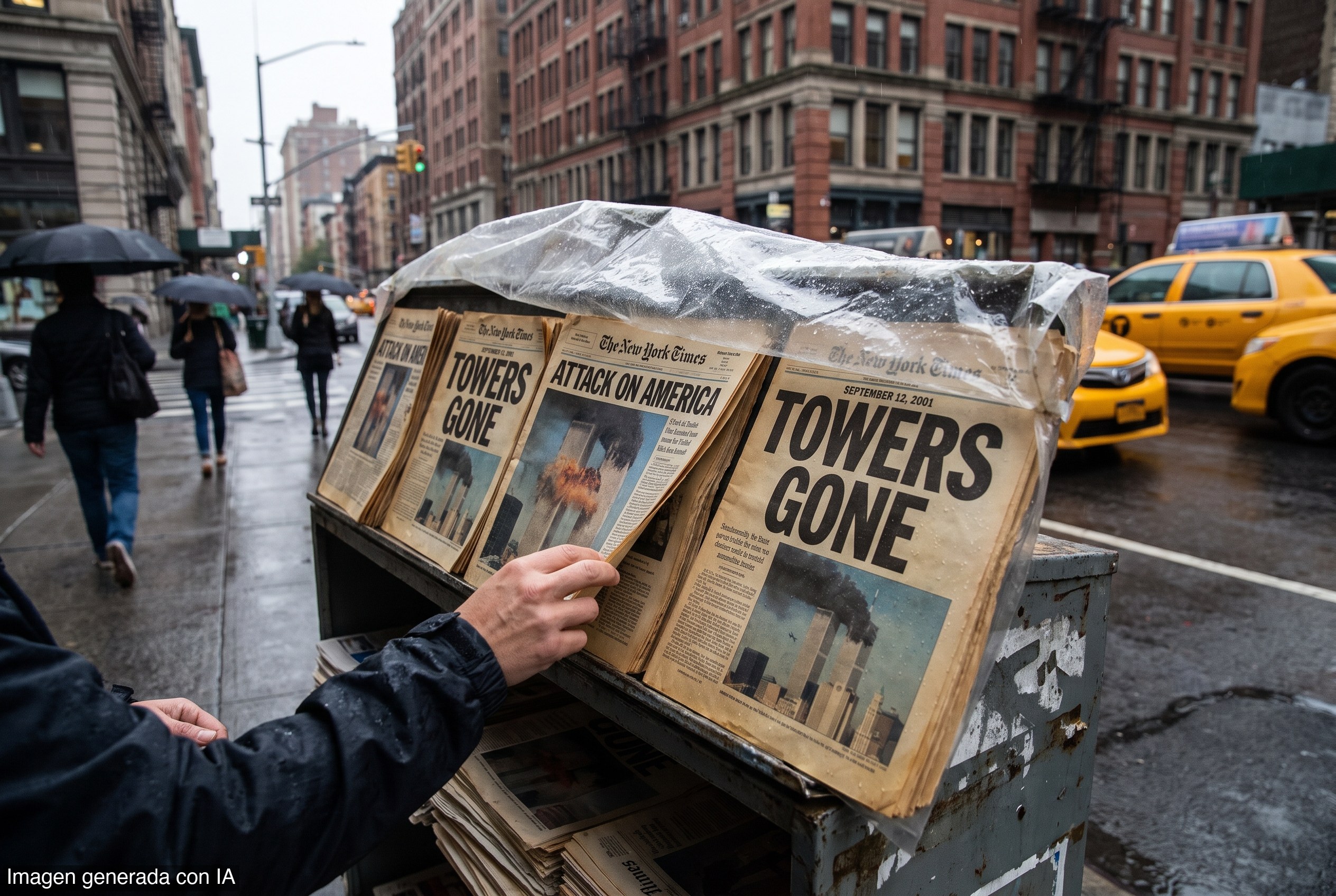
Journalism is often described as 'the first rough draft of history.' Nicholas Clairmont takes that phrase literally and rereads what New York newspapers published on September 12, 2001.
He says his mother bought all four major New York City newspapers that morning: The New York Times, The Wall Street Journal, The New York Post, and The New York Daily News. Years later, after many moves, he found those yellowed copies again in a storage bin in Miami and kept them.
The personal detail matters because it marks how long the evidence survives after the event. Clairmont remembers watching the looping footage of the Twin Towers collapsing on television, with the smell of jet fuel lingering into the fall. Then he points to the newspapers themselves as artifacts of a country trying to understand what had just happened before memory could be edited by time.
That is the point worth keeping. The newspapers were not a perfect final verdict, but they were a first account, and first accounts have value precisely because they are made before consensus, before hindsight, and before the incentives of later storytelling take over.
Clairmont's own household story also serves as a reminder that the objects people dismiss as clutter can become the record. He and his mother fought over what to keep and what to throw away in a storage unit near Biscayne Boulevard. She called the newspapers and other belongings 'artifacts of various phases of our family life and the material culture of American society.' He argued that if you can stand to not have something in your house, you do not need it.
He kept the papers anyway.
Say it plainly: printed newspapers are not merely nostalgic objects. They are evidence. They show what was knowable at the time, not what later commentators would like history to have been. In an age that prizes speed and then forgets what was actually published, the old front page still has a public function. It pins down the sequence. It limits revision. It reminds us that institutions can get closer to the truth when they are forced to act before the story is complete.
And there is a deeper lesson for a country that now treats every event as a content cycle. The record is public, but memory is not the same thing as the record. The paper in your hands can outlast the newsroom chatter, the cable chatter, and the polished retrospective. What survives is what can be checked. What matters is what was written down.
That is why Clairmont's yellowed newspapers matter beyond sentiment. They are not just family keepsakes. They are a small defense of reality against drift, and of the discipline required to keep history tethered to fact.